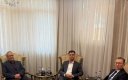
Key Regional Issues Considered at the 49th Session of the Almaty Regional Maslikhat
At the regular 49th session of the Almaty Regional Maslikhat, chaired by Kuat Baigodzhayev, deputies considered a wide range of issues affecting the daily life and future development of the region. The agenda included amendments to the General Plan of the city of Konaev, a housing renovation program, forest protection measures, and the introduction of water-saving technologies.
The session was attended by First Deputy Akim of the Almaty Region Kanat Yesbolatov, heads of regional departments, and representatives of law enforcement agencies. Akims of cities and districts also joined the meeting online.
One of the key issues was the discussion of amendments to the General Plan of Konaev. Head of the Department of Architecture and Urban Planning of the Almaty Region Bolat Musylmanbekov presented a proposal to revise the city boundaries aimed at creating an integrated and effective management system for the regional center. A major focus is the formation of a compact administrative and business core to accommodate government bodies and central agencies.
While the current population of Konaev is slightly more than 56,000 people, it is expected to reach approximately 205,000 by 2050, representing almost a fourfold increase. Therefore, previous urban development approaches are no longer sufficient. The updated plan provides for balanced construction of housing, schools, hospitals, and other social facilities.
Deputies also revisited the issue of outdated housing. A housing renovation program is being launched in the region. Old buildings will either be purchased or demolished with residents’ consent, and new residential complexes will be constructed in their place. The program will be financed through a mixed model, with funds provided from the budget and additional investment attracted from private investors. Authorities expect this approach to modernize the housing stock without placing excessive pressure on the regional budget while encouraging business participation in urban development.
Another important topic was water conservation. Previously, water-saving measures were mainly introduced in agriculture, but now they are being expanded to urban areas. Amendments have been made to the “Taza Kazakhstan” program, making drip irrigation systems and other water-saving technologies mandatory in landscaping projects. These measures will apply to several cities, including Konaev, Alatau, Esik, Kaskelen, and Talgar.
Forest protection issues were also discussed. According to the Department of Natural Resources, the region has more than two million hectares of forest land. Their condition is monitored by specialized services using drones and surveillance cameras. Hundreds of millions of tenge have been allocated this year for wildfire prevention. In 2026, 912 million tenge from the local budget was allocated for the purchase of firefighting equipment. Five stationary monitoring posts operating around the clock, eight unmanned aerial vehicles, and a network of 18 surveillance cameras are being used to monitor fire-prone areas. As part of the Head of State’s initiative to plant two billion trees, 43.7 million seedlings have been planted in the region since 2021 across nearly 20,000 hectares.
The Department of Digital Technologies proposed introducing incentive allowances for employees of the Information Technology Center. The organization employs 50 people. The current salary level, especially amid rising housing rental costs in the region, contributes to the outflow of qualified specialists. More than 35 million tenge is planned to be allocated for additional payments from April to December 2026.
During the session, deputies asked questions regarding timelines, financing, and implementation mechanisms. Particular attention was paid to the renovation program and the introduction of water-saving technologies. After receiving detailed explanations, all nine agenda items were supported.
During the discussion of the submitted projects, deputies of the Regional Maslikhat raised additional questions to the speakers. They were particularly interested in the details of financing the renovation program, specific timelines for implementing amendments to the General Plan of Konaev, and practical mechanisms for introducing water-saving technologies. After receiving comprehensive explanations from the heads of relevant departments, the deputies supported the proposed initiatives.