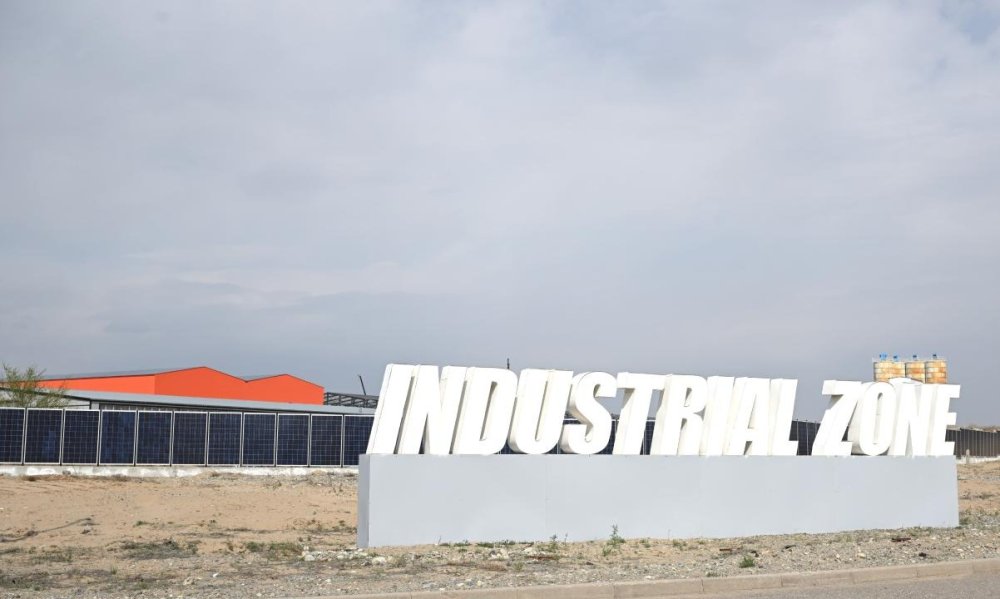
Work on developing cross-border trade and logistics hubs in Kazakhstan is continuing and gradually moving from the planning stage to concrete implementation. The focus is no longer limited to building infrastructure along the borders: projects are now moving into the construction of production facilities, attraction of investment, launch of new logistics capacities and the development of initial cargo flows. The Ministry of Trade and Integration is coordinating work on five key hubs designed to strengthen Kazakhstan’s trade ties with Kyrgyzstan, Uzbekistan, Russia, China and the Caspian region. Their development is expected to streamline logistics procedures for businesses and contribute to increasing non-commodity exports to 30%.
The most visible progress is being made in the eastern direction. At the Khorgos – Eastern Gate Special Economic Zone (SEZ), the number of projects has increased from 14 in 2022 to 69, while the volume of attracted investment has grown from KZT 340 billion to KZT 652.8 billion. Today, 40 projects worth KZT 75 billion are being implemented, creating 864 jobs. In the first half of 2026 alone, nine new participants were registered, with investments totaling KZT 9.3 billion and 230 jobs to be created. During the same period, the value of manufactured products reached KZT 12.7 billion, up 74% compared with the same period in 2025.
The infrastructure at Khorgos is also expanding. The SEZ already has an inland dry port with an annual capacity of 540,000 containers, as well as a 25,000-square-metre Class A warehouse complex. Two more major logistics projects are currently at the design stage. By 2028, 28 projects worth KZT 577.7 billion are planned for implementation, creating around 2,800 jobs. Among the largest initiatives are the Kazakhstan–China International Industrial City industrial park, valued at KZT 330 billion, and an international passenger and cargo airport worth KZT 250 billion.
In southern Kazakhstan, projects are also moving into practical implementation. At the Central Asia International Center for Industrial Cooperation, fencing of the 100-hectare site has been completed, while internal roads and engineering infrastructure are under construction. External construction and installation works have been completed, and commissioning activities are now underway. Internal engineering infrastructure is 55% complete, with the remaining works scheduled for completion in December 2026. The local akimat has already fully completed the construction of eight production buildings, while the investment project pipeline for the center has reached KZT 89.4 billion. Construction has already begun on one of the largest projects — an industrial park worth KZT 75.3 billion.
In the Zhambyl Region, the Industrial Trade and Logistics Complex was granted Special Economic Zone status in April 2026. A 165-hectare site has been allocated for the project, and a programme for connecting the complex to engineering networks has been developed. Construction of the first-stage substation began this year. Of the KZT 12 billion allocated for these purposes, around KZT 4 billion has been provided in 2026, with the remaining funds planned for next year. At the same time, preparations for the site and the complex’s infrastructure are continuing.
The western direction is also undergoing active development. The Eurasia Cross-Border Trade Center in the West Kazakhstan Region covers 281 hectares. Part of the external engineering infrastructure has already been completed, including gas, electricity, water supply and wastewater systems. Projects are being implemented in the industrial zone for the production of asphalt concrete, recycling of automotive tires, manufacturing of aerated concrete products and construction of a gas-turbine power plant. At the same time, work is underway to establish the Eurasia Special Economic Zone, which is expected to create additional conditions for attracting investment and localizing production.
The Caspian region is seeing its own progress. Practical operations at the Aktau International Container Hub have already begun at the Port of Aktau: the first container train arrived on July 14, 2026. To date, 233 containers, equivalent to 444 TEUs, have been received. The project is being implemented in stages and is expected to increase the port’s annual container handling capacity to 240,000 TEUs, compared with the current 70,000 TEUs.
Another major facility in the Caspian hub is the container terminal at the ERSAI Industrial Port. Construction is approximately 85% complete. Ten kilometers of internal port railway tracks have already been built, while the container yard and crane tracks are nearing completion. The terminal is scheduled to be commissioned on October 1, 2026. Once it reaches full capacity, it will be able to handle up to 120,000 TEUs annually and accommodate up to 300 vessels per year. Private investment in the project exceeds KZT 15 billion.
Overall, the five cross-border hubs are gradually forming an integrated infrastructure network designed to connect Kazakh businesses with the major markets of neighboring countries. In some locations, production facilities are already operating; in others, the first container trains have arrived, while elsewhere engineering infrastructure is nearing completion and construction of new facilities is getting underway. The next stage will be to bring these projects to full capacity, expand the investor base and further increase trade and transit volumes across Kazakhstan’s borders.