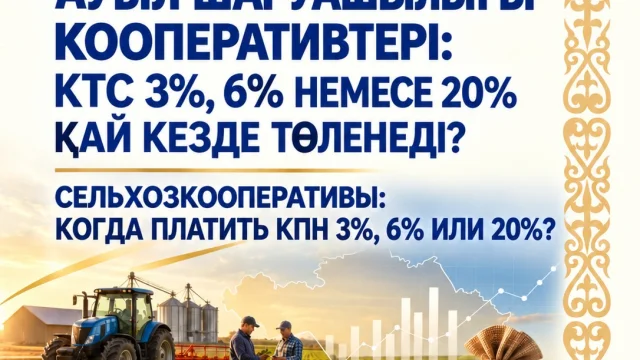
AGRICULTURAL COOPERATIVES: WHEN SHOULD I PAY 3%, 6%, OR 20% CPN? Starting from January 1, 2026, Kazakhstan has differentiated corporate income tax (CIT) rates for agricultural production cooperatives (SPCs). The main rule: The rate depends not just on the status of the cooperative or the OKED code, but on what exactly it does and where it gets its products from. 3% Its products 6% SEC activities 20% Other activities When does 3% apply? If the cooperative is a direct producer of agricultural products. Examples: The SEC independently grows wheat and sells the crop. The cooperative breeds cattle and sells the raised breeding young. SEC produces its own milk, processes it into cheese, butter or other dairy products and sells the finished product. Condition: the products must be produced in-house by the cooperative. When is 6% applied? If the SEC carries out cooperative activities provided for by the Tax Code that do not fall under the 3% rate. Examples: The cooperative buys the milk produced by its members, processes it and sells the finished products. SEC harvests, stores, and sells grain grown by cooperative members. The cooperative provides its members with zootechnical and other auxiliary services for the production of agricultural products. The SEC sells to its members goods for the production and processing of agricultural products. Important: products purchased from SEC members do not become products of the cooperative's own production. Therefore, the processing of such raw materials refers to the rate of 6%, not 3%. When is 20% applied? If the SEC receives income from other activities that do not comply with the terms of the 3% or 6% rates. Examples: The SEC buys milk from third-party suppliers who are not members of the cooperative, processes and sells products as part of its independent activities. The cooperative provides commercial zootechnical services to third-party organizations. SEC is engaged in independent trading or other activities not provided for in Article 16 of the Tax Code. For such transactions, the rate is determined taking into account the actual nature of the activity and possible special provisions of the Tax Code. Let's look at one example. SEC Bereke is engaged in the production and processing of milk. Own milk → cheese → sale KPN 3% Milk from SEC members → cheese → sale KPN 6% Milk from third-party suppliers → cheese → sale CPN of 20% if the activity does not fall under preferential categories What if a cooperative conducts several types of activities at once? It is necessary to keep separate tax records for activities that are taxed at different rates. This means that you need to separately account for the relevant income, expenses and calculate taxable income. Three mistakes to avoid 1. Consider that any SEC is automatically entitled to a 6% rate on all income. 2. Apply 3% to milk processing only because it was purchased from cooperative members. 3. Focus solely on the OKED code, without taking into account the actual nature of the activity. Save this post and share it with the heads of agricultural cooperatives! The correct determination of the CPI rate will help to avoid errors in tax reporting and additional charges. Department of State Revenue for Kostanay region Basis: Articles 16, 211, 345 and 357 of the Tax Code of the Republic of Kazakhstan dated July 18, 2025 No. 214-VIII.
FARMS: HOW TO PAY TAXES IN 2026? Is it possible to combine two tax regimes? What taxes do I not have to pay? And what has changed for farmers? Since January 1, 2026, a special tax regime with a number of advantages has been in effect for peasant and farm enterprises (farms). Let's take apart the most important! 0.5% The CPI rate for agricultural farms 2 modes It can be combined if the conditions are met 1. Who can apply the special mode? Peasant and farm farms that have land plots in Kazakhstan on the right of ownership or land use, including secondary. It is important to observe the restrictions on the total area of agricultural land: 1st territorial zone — up to 5,000 hectares; 2nd zone — up to 3,500 ha; 3rd zone — up to 1,500 hectares; The 4th zone is up to 500 hectares. The specific zone is determined based on the location and characteristics of the land plot. 2. What taxes do I not have to pay? When applying the SNR for farms, exemption from the following taxes and payments is provided: Land taxes and fees for land — for plots used under the SSR, with exceptions provided for by law. Taxes on transport and property — according to the established categories of objects. Social tax — for activities within the framework of the Social Tax System. Fees for negative environmental impact — for the relevant activity. VAT — excluding VAT on imports and for non-residents. At the same time, social payments and duties of the tax agent remain. 3. Is it possible to combine the CPR for farms with a simplified version? YES! If the farm receives income from different types of activities. For example: Growing and selling your own wheat is an agricultural resource for farms. Provision of agricultural machinery services to third—party organizations is a simplified declaration if the conditions of its application are met. The main rule is to keep separate records of income, expenses, assets and liabilities in different areas of activity. If there is a duty for farms to register VAT for activities outside the Central Tax System, it is necessary to switch to a generally established taxation procedure. 4. And if we recycle the purchased products? The CPR for farms applies to: Production and sale of own agricultural products. Processing of own-made products. The sale of such processed products. The purchase of other people's products for processing and sale by itself does not fall under this Tax Code. For such activities, it is necessary to determine another acceptable taxation regime. The production, processing and sale of excisable goods are also excluded from this Tax Code. Government of Kazakhstan 5. How do I submit reports? TNF 920.00 — declaration of the Tax Code for farms, for a calendar year, no later than March 31 of the following year. TNF 910.00 — when applying a simplified declaration for other activities. TNF 200.00 — to reflect the personal income tax at the source of payment and social payments for employees. Social payments for the head and members of the farm are reflected in TNF 920.00. The main thing to remember is that the special regime for farms reduces the tax burden, but its benefits apply only to activities that comply with the terms of the Tax Code. Save the publication so that you don't make a mistake when choosing the tax regime, and share it with other agricultural producers! Basis: Articles 715, 728-733 of the Tax Code of the Republic of Kazakhstan dated 07/18/2025 No. 214-VIII.
Sale of an apartment received as a gift: when does the obligation to pay the personal income tax arise? We explain the procedure for taxation of personal income when selling real estate received as a gift. For example, a citizen received an apartment as a gift in 2025 and decided to sell it in 2026. In this case, is there an obligation to pay individual income tax (IIT)? In accordance with Articles 382 and 383 of the Tax Code of the Republic of Kazakhstan, when selling residential real estate, tax obligations depend on the period of ownership of the property and the availability of income from the increase in value. When does the income from the increase in value arise?** When selling an apartment that has been owned for less than one year, if ownership was registered before January 1, 2026, or for less than two years, if ownership was registered after January 1, 2026, income from the increase in value may arise. Income is defined as the positive difference between the sale price and the original value of the property. When selling an apartment received free of charge, the initial cost is determined in accordance with the norms of the Tax Code. In particular, for real estate that is subject to personal property tax, the estimated value determined for calculating property tax as of January 1 of the year of ownership is applied. What needs to be considered? If a taxable income arises as a result of the sale, the individual independently calculates the personal income tax, submits a declaration of income and property and pays the tax within the time limits established by law. In order to determine tax obligations, it is necessary to take into account the date of state registration of ownership rights, the type of real estate and the applicable provisions of the Tax Code. The Department of State Revenue for Kostanay region recommends that citizens clarify their tax obligations in advance when planning real estate transactions.
When buying an expensive passenger car, you must pay an excise tax. Since 2026, the Tax Code of the Republic of Kazakhstan provides for the imposition of excise duty on passenger cars, the purchase price of which is 18,000 times the monthly calculation index (MCI) effective on January 1 of the corresponding fiscal year and higher. Who is the excise tax payer? According to Article 535 of the Tax Code of the Republic of Kazakhstan, individuals who purchase such cars in Kazakhstan are recognized as excise tax payers. The requirement applies, among other things, to used cars purchased from previous owners if the purchase price reaches a set threshold. How is the excise tax calculated? In accordance with Article 537 of the Tax Code, the excise tax rate is **10% of the value of the purchased vehicle. When purchasing a car in the territory of the Republic of Kazakhstan, the cost is determined based on the price specified in the purchase agreement or other agreement on the basis of which the vehicle was purchased. Do I need to pay an excise tax on the subsequent resale of the car? Yes. If a new buyer purchases a car at a cost equal to or exceeding the established threshold, he has an independent obligation to pay excise tax. In this case, the excise tax paid by the previous owner is not counted against the obligations of the new buyer. In what time frame is it necessary to fulfill obligations? An individual needs to: - submit an excise tax declaration in the form 400.00 no later than the 15th day of the month following the month of purchase of the car; - pay the excise tax no later than the earliest of the two dates: the 20th of the month following the month of purchase, or the date of submission of documents for state registration of the vehicle. Thus, when buying an expensive passenger car, it is important to take into account in advance not only its cost, but also the tax obligations associated with the purchase. Basis: Articles 535, 536, 537, 539, 549 and 551 of the Tax Code of the Republic of Kazakhstan.
The Department of State Revenue for the city of Kostanay recalls that in order to promptly assist the population in clarifying tax and customs issues, improving public awareness and receiving feedback, there is a chatbot in Telegram "@SalyqBot", implemented by the State Revenue Committee of the Ministry of Finance of the Republic of Kazakhstan. @SalyqBot is a digital tax consultant, developed in Kazakh and Russian languages and has very useful functions: "Account unblocking"; "Personal tax assistance"; "Bankruptcy"; "Video Call"; "Prompt assistance on customs issues"; "Salyq AI 2026"; "TOP Questions"; "Ask the operator a question"; "Electronic services"; "Calculators"; The "Directory"; "Tax calendar"; "Polls"; "Video Tutorials". The chatbot is available under the name "@SalyqBot" or via a direct link. https://t.me/salyqbot .
The taxpayer (tax agent) has the right to: suspend the submission of tax reports; resume the submission of tax reports before the suspension period expires. It is mandatory for a taxpayer to resume submitting tax reports upon resumption of business. The total period of suspension of tax reporting should not exceed the limitation period. In the period from the date of suspension to the date of resumption of the submission of tax reports to the value added tax payer, the issuance of electronic invoices is suspended. If there are taxable objects, the submission of tax reports by the taxpayer (tax agent) is not suspended. Information on the suspension (or) resumption of tax reporting is published on the authorized body's Internet resource no later than the date of the relevant decision by the tax authority. The publication on the Internet resource of the authorized body of information on the suspension and (or) resumption of tax reporting is the basis for the failure to submit tax reports for the period specified in the tax statement or the appeal of the local executive body. A refusal to suspend the submission of tax reports by a taxpayer (tax agent) is accepted in the case of: tax arrears, arrears on social payments; if the taxpayer is included in the register of inactive taxpayers; the presence of unfulfilled notifications from the tax authority. The tax authority recognizes the submission of tax reports as resumed in the case of: submission by the taxpayer (tax agent) of tax reports from the date of submission of tax reports; the discovery of the fact of the taxpayer's resumption of activity during the period of suspension or from the date of resumption of activity. The resumption of activity is recognized as the beginning of a taxpayer's activity that leads to a tax obligation to calculate, pay taxes, make payments to the budget and social obligations.