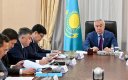
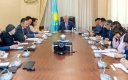
A regular meeting of the Economic Growth Headquarters was held under the chairmanship of Deputy Prime Minister and Minister of National Economy of the Republic of Kazakhstan SerikZhumangarin
Meeting participants focused on the development of non-oil sectors, which remain key drivers of economic growth despite the temporary decline in oil production. These sectors include construction, manufacturing, trade, transportation, and agriculture.
Construction continues to show the highest growth rates. By the end of the seven months, a further increase in construction volumes and continued strong growth in the sector are expected. The highest growth rates are projected forUlytau, Abay, and Kyzylorda regions.
Manufacturing also demonstrated strong growth, with production volume increasing by 9.8%. The main contributors were mechanical engineering (+23.2%), chemical industry (+19.0%), food production (+14.7%), and light industry (+89.2%). Similar growth rates are expected to be maintained by the end of the seven months.
The positive trend in trade also continues. According to the resultsofthe first half of the year, trade turnover reached 36.2 trillion tenge, and the trade volume index was 105.7%. To further expand the industry, regions have been instructed to implement trade development roadmaps, which provide for the launch of new investment projects.
In the transport sector, it has been noted that, despite an overall increase in transportation volumes, growth rates are being constrained by a decline in oil and gas transportation. In this regard, SerikZhumangarininstructed that the country's transit potential be maximized, primarily by rail and road.
Sustainable growth in agriculture is expected by the end of the seven months. An increase in food and beverage production is also projected. This positive trend is being driven by the harvesting campaign, the development of livestock farming, and record levels of concessional financing for the agro-industrial complex. Dairy farms, whose construction was financed underpreferential terms in 2024–2025 and which are now reaching their design capacity, are beginning to make a significant contribution to the industry's growth. This is already reflected in an increase in milk production. In the first half of 2026, milk production reached 1.9 million tons, an increase of 2.4% compared to the same period in 2025.
Summing up the meeting, Serik Zhumangarin emphasized that Kazakhstan continues to implement large-scale infrastructure projects that are expected to ensure long-term economic growth.
"In this regard, it is essential to begin preparing high-quality projects now that will ensure long-term economic impact and are consistent with the system of regional standards: healthcare and social facilities, with a particular focus on bridges, crossings, key transport arteries, and energy facilities financed from the national budget. The country is large and continues to develop rapidly, so the volume of projects being implemented must increase annually,"the Deputy Prime Minister noted.
https://www.gov.kz/memleket/entities/economy/press/news/details/1263964?lang=en