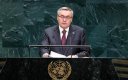
President Kassym-Jomart Tokayev delivered remarks at a joint session of the Senate and Mazhilis (lower chamber of Parliament) on June 30, 2026, marking the conclusion of the current parliamentary convocation and the entry into force of Kazakhstan’s new Constitution. Describing the occasion as a historic turning point, the President said the country was entering a fundamentally new stage of state development, with the constitutional reforms laying the institutional foundation for a “New Kazakhstan.”
The President highlighted the adoption of more than 300 laws over the past three years to support the country’s political and economic transformation. He described the forthcoming elections to the new unicameral Kurultai as an opportunity to demonstrate open, honest and competitive democratic politics.
The speech marked the formal transition from the previous constitutional system to the institutional framework established by the new Constitution. It also served as the President’s strategic roadmap for the next phase of Kazakhstan’s political, economic and technological development, outlining the Government’s priorities following the constitutional reforms.
- The new Constitution enters into force, marking the beginning of a new phase of constitutional development.
- The President announced that he will sign a decree calling elections to the new unicameral Kurultai.
- Kazakhstan will begin construction of its first nuclear power plant next year.
- More than 13 GW of new electricity generation capacity will be commissioned by 2029.
- Kazakhstan will continue implementing the nationwide Digital Qazaqstan Strategy and the “ Data Center Valley ” megaproject.
- More than KZT 19 trillion ($39 billion) has been allocated to education, healthcare, science and social development this year.
- The President reaffirmed that the constitutional reforms are intended to build a “Just, Strong, Safe, Clean and Advanced Kazakhstan.”
President Tokayev said Kazakhstan’s next phase of development would focus on five strategic priorities designed to strengthen state institutions, accelerate economic diversification, modernize infrastructure, advance digital transformation and invest in human capital.
Modernizing State Institutions
- Constitutional reform: The new Constitution enters into force, marking the beginning of a new stage of Kazakhstan’s political development.
- New legislative system: The bicameral Parliament will be replaced by a unicameral Kurultai under the new constitutional architecture.
- Institutional balance: The constitutional reforms preserve Kazakhstan as a presidential republic while strengthening legislative institutions and improving the balance between branches of government.
- Digital parliament: The future Kurultai will adopt modern digital tools, predictive analytics and AI to improve the quality and speed of legislation.
- Public participation: Greater public involvement in lawmaking will be supported through digital consultations and wider expert engagement.
- People’s Council: A new constitutional body, the Kazakhstan Halyk Kenesi (People’s Council), will unite representatives of maslikhats, public councils, expert platforms and civil society organisations while assuming the functions previously carried out by the Assembly of the People of Kazakhstan.
- Direct democracy: National referendums have become an established element of Kazakhstan’s political system, with three nationwide referendums held since 2022.
Transitioning to a New Economic Model
- Economic performance: Kazakhstan’s economy grew by 6.5% last year, with GDP exceeding $300 billion for the first time and GDP per capita reaching $15,000. Inflation has declined to 10.4%, with further reduction remaining a government priority.
- Investment: Foreign direct investment increased by 14% last year, with growing investment directed towards manufacturing, logistics, digital infrastructure and finance.
- Economic reform: Newly adopted Budget and Tax Codes establish the foundations of a new economic model and modern public finance management.
- Industrial development: Between 2023 and 2025, 540 industrial projects worth KZT 3.7 trillion ($7.6 billion) were implemented, with more than 200 additional production facilities planned over the next two years.
- SME support: Small and medium-sized businesses now account for more than 40% of GDP, while approximately half of Kazakhstan’s working-age population is employed in the SME sector.
- Agriculture: Record levels of concessional financing have supported agricultural modernisation, helping agro-industrial output reach nearly KZT 10 trillion ($20.6 billion) and exports rise to $7 billion.
- Alatau: The new Constitutional Law on the Special Legal Regime of the City of Alatau establishes a new investment platform designed to attract international business and develop high-technology industries.
Strengthening Energy and Infrastructure
- National infrastructure programme: A major National Project has been launched to modernise Kazakhstan’s energy and utilities infrastructure, backed by more than KZT 1 trillion this year ($2.05 billion).
- Energy security: Kazakhstan plans to increase gasification from approximately 65% to 80%, while commissioning more than 13 GW of new electricity generation capacity by 2029.
- Balanced energy mix: The President reaffirmed Kazakhstan’s commitment to developing renewable energy while making full use of the country’s conventional energy resources, including clean coal technologies.
- Nuclear energy: Construction of Kazakhstan’s first nuclear power plant will begin next year following public approval in the 2024 referendum.
- Middle Corridor: Freight volumes along the Trans-Caspian International Transport Route (Middle Corridor) have increased fivefold during the past six years, strengthening Kazakhstan’s position as a major Eurasian transit hub.
- Rail infrastructure: Major railway expansion projects continue across the country, including new rail lines and increased freight capacity.
- Road network: Kazakhstan is undertaking the largest road modernisation programme in its history, with 13,000 kilometres of roads under construction or repair.
- Construction: The President called for accelerating large-scale infrastructure construction, describing investment in productive infrastructure as essential for long-term national prosperity.
Building a Fully Digital State
- Digital legislation: Kazakhstan became one of the first countries to adopt both a Digital Code and a dedicated Law on Artificial Intelligence.
- AI strategy: The President approved the new nationwide Digital Qazaqstan Strategy, placing artificial intelligence at the centre of economic and public sector modernisation.
- Public administration: The Government will transition towards a “Government as a Platform” (GovTech) model, using AI and digital technologies to modernize public administration and improve service delivery.
- Digital rights: The Constitution now guarantees citizens’ right to personal data protection in cyberspace.
- Government modernisation: AI and digital technologies will be integrated throughout public administration to improve government efficiency and service delivery.
- Digital economy: Kazakhstan’s e-commerce market has grown almost eightfold during the past five years, reaching KZT 3.7 trillion.
- Data infrastructure: The “Data Centre Valley” project will establish advanced computing capacity and attract global technology companies to Kazakhstan.
- Education: New AI-focused schools and Central Asia’s first specialised university dedicated to artificial intelligence will support the development of future digital talent.
Investing in Human Capital
- Social investment: More than $39 billion (over half of the national budget) has been allocated this year to education, healthcare, science, culture, sport and social protection.
- Equal opportunity: The President emphasized that justice means creating equal opportunities for every citizen, with equality before the law serving as its fundamental principle.
- Recovered assets: More than KZT 1 trillion ($2.05 billion) in illegally acquired assets has been returned, with much of the funding directed towards new schools, hospitals and public infrastructure.
- National Fund for Children: More than US$2.3 billion has been credited to the accounts of 6.5 million children under the programme.
- Science and universities: Kazakhstan continues expanding cooperation with leading international universities while strengthening domestic scientific research through the new Law on Science and Technological Policy.
- Schools: Over the past three years, 584 modern schools have been built nationwide, with further expansion planned this year.
- Healthcare: Nearly 1,300 healthcare facilities have been built since 2019, while life expectancy has risen to almost 76 years.
- Support for workers: Teachers, healthcare workers and social workers have received substantial salary increases, while new protections have been introduced for employees in hazardous industries.
- National identity: The President reaffirmed the importance of preserving Kazakhstan’s cultural heritage, including the celebration of National Dombra Day and continued support for the country’s spiritual and cultural development.
International dimension
- Kazakhstan reaffirmed its commitment to a balanced foreign policy despite increasing geopolitical uncertainty.
- The President highlighted growing foreign investment, particularly in manufacturing, logistics, digital infrastructure and finance.
- The Middle Corridor continues to expand, with freight volumes increasing fivefold over six years.
- Kazakhstan aims to strengthen its role as a regional transport and logistics hub.
- The President reaffirmed Kazakhstan’s ambition to become a Eurasian digital and technology hub.
President Tokayev concluded by stating that the constitutional reforms mark the beginning of a new stage in Kazakhstan’s development rather than the end of the reform process. He announced that elections to the new Kurultai would be held in accordance with the new constitutional framework and expressed confidence that the country’s renewed political institutions would strengthen democratic participation, accelerate economic modernisation and support the long-term development of a Just, Strong, Safe, Clean and Advanced Kazakhstan.