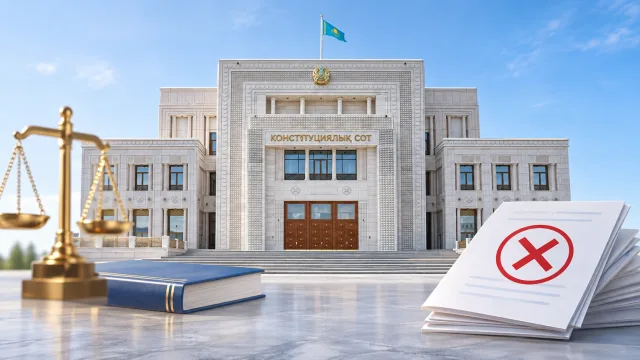
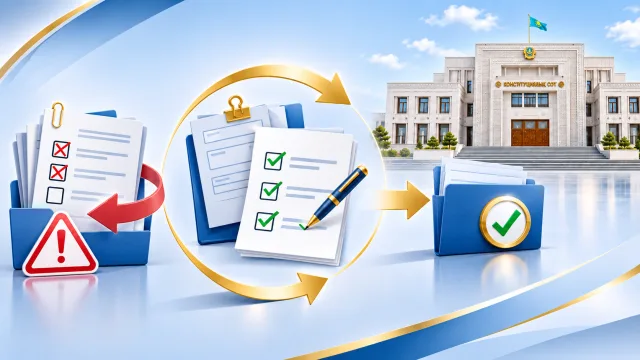
The Constitutional Court of the Republic of Kazakhstan examined an application challenging the constitutionality of subparagraph 14) of paragraph 1 of Article 52 of the Labour Code, which provides for the termination of an employment contract with an employee performing educational and upbringing functions for committing an immoral act incompatible with the continuation of their work.
The applicant was dismissed on the basis of a decision by the school's Council on Pedagogical Ethics. Disagreeing with her dismissal, she appealed to the conciliation commission and the courts. The judicial decisions rendered in the case were upheld.
According to the applicant, the absence of clearly defined legal characteristics and objective criteria for determining immoral misconduct allows for broad discretion in applying the provision and violates her rights to work and judicial protection.
The Constitutional Court noted that the legislation establishes normative standards of morality, including specific requirements for professional ethics in education and liability for their violation.
The concept of “immoral misconduct” is inherently evaluative and therefore cannot be exhaustively defined through a closed list of actions. Assessing such misconduct requires consideration of the circumstances of each individual case, as well as its social, cultural and professional context.
The Court concluded that the concept has a sufficient degree of legal certainty to allow its application in light of the specific circumstances of each case. The Court also noted that the applicant had exercised the legal mechanisms available to protect her rights by applying to the conciliation commission and the courts.
Follow memleket.kz on social media
Important news from Kazakhstan and useful articles on the platform you prefer.