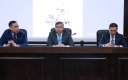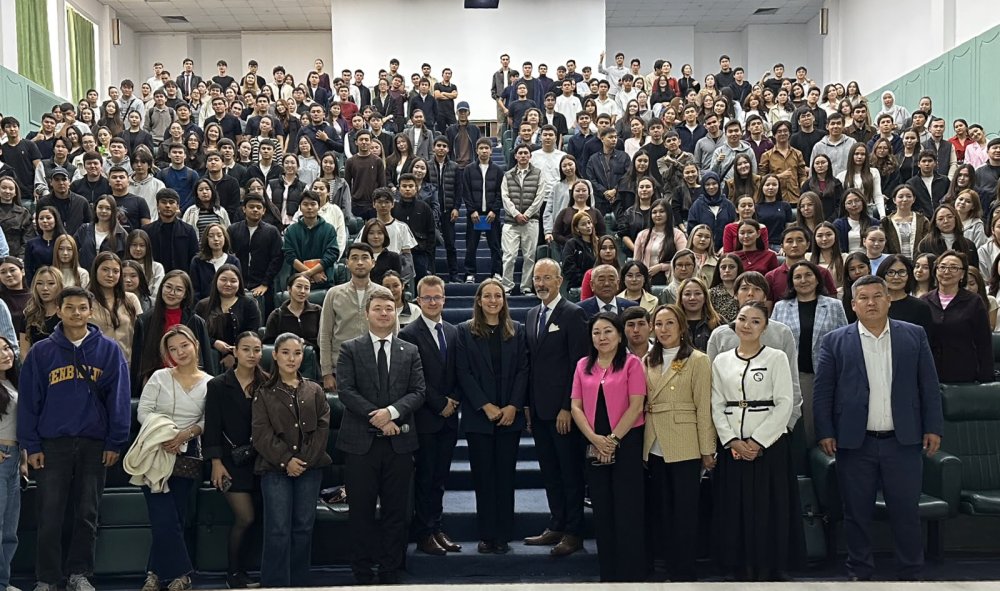
On October 1, 2026, Farabi University hosted the second meeting with representatives of the Organisation for Economic Co-operation and Development (OECD). This time, OECD experts delivered an open lecture for students, attracting around 350 participants.
The event continued the dialogue launched the previous day between OECD representatives and the academic staff of the Higher School of Economics and Business. While the first meeting focused primarily on faculty members and opportunities to integrate integrity principles into university curricula, the second session was designed specifically for students.
The lecture was held as part of the OECD project “Fair Market Conditions for Competitiveness in Kazakhstan” and focused on “Introduction to Integrity / Integrity in the Private Sector.”
The session was delivered by William Tompson, Head of the OECD Eurasia Division; Céleste Laporte-Talamon, Policy Analyst for Central Asia; and Egor Polishchuk, Junior Policy Analyst for Central Asia.
At the beginning of the lecture, the experts introduced students to the OECD, its key areas of activity, and the development of cooperation between Kazakhstan and the Organisation. They noted that Kazakhstan’s cooperation with the OECD has expanded since 2008. Kazakhstan also participates in several regional initiatives, including the OECD Eurasia Competitiveness Programme and the Anti-Corruption Network for Eastern Europe and Central Asia.
A central topic of the session was the concept of integrity, presented as a positive commitment to transparency, accountability, and honest dealing. The experts discussed practices that can undermine integrity, including bribery, conflicts of interest, bid rigging, and facilitation payments.
Particular attention was given to why integrity matters for the private sector and the economy as a whole. The speakers discussed how corruption risks can affect competition, foreign direct investment, international trade, and long-term economic growth. The lecture also addressed specific features of Kazakhstan’s economy and the importance of creating fair and transparent conditions for doing business.
Students were also introduced to key OECD instruments, including the OECD Guidelines for Multinational Enterprises on Responsible Business Conduct, the OECD Anti-Bribery Convention, and the OECD Due Diligence Guidance for Responsible Business Conduct. Through practical examples, the speakers demonstrated how international standards can be applied in companies’ relations with government institutions, business partners, suppliers, and local communities.
An important part of the programme was a case workshop, which gave participants an opportunity to apply the concepts discussed during the lecture to practical situations. Overall, the session covered six thematic areas: an introduction to the OECD and OECD–Kazakhstan cooperation, the concept of integrity, the importance of integrity for the private sector, OECD instruments, OECD findings on Kazakhstan, and practical case-based work.
The participation of around 350 attendees demonstrated strong interest in the topic. The meeting gave students a valuable opportunity to engage directly with international experts, learn about OECD approaches and standards, and discuss the importance of transparency, accountability, and integrity for future economists, managers, entrepreneurs, and public-sector professionals.
As part of the visit, a campus tour of Farabi University was also organized for the OECD representatives. The guests had an opportunity to explore the university’s infrastructure and visit the University Museum, where they learned about the history and development of Farabi University, its major achievements, and its contribution to education and research in Kazakhstan.
A particular highlight of the campus tour was a visit to Farabi University’s supercomputer center. The OECD representatives were introduced to the university’s advanced computing infrastructure and its potential for scientific research, large-scale data processing, digital technologies, and artificial intelligence.
The two-day programme, which brought together OECD experts, faculty members, and students, provided an important platform for professional and academic dialogue. The visit also allowed the OECD delegation to gain a broader understanding of Farabi University’s academic, scientific, and technological potential and contributed to exploring further opportunities for cooperation between Farabi University and the OECD in education, research, and the promotion of responsible business conduct.