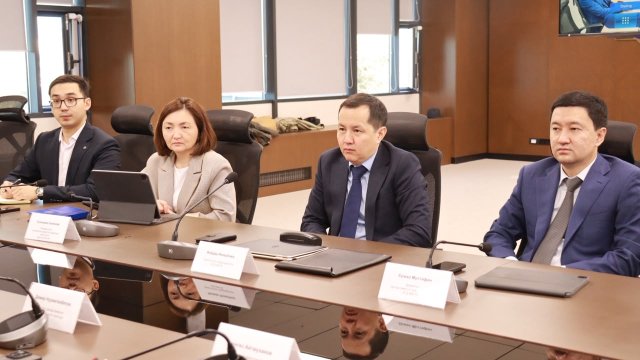
On October 8, 2026, in Astana, Deputy Chairman of the State Revenue Committee of the Ministry of Finance of the Republic of Kazakhstan, Jaidar Inkerbayev, held a meeting with representatives of the international technology company Webb Fontaine. The meeting was a continuation of an earlier videoconference. Webb Fontaine specializes in the digitalization of foreign trade and customs administration. The company develops digital solutions for government agencies and businesses, including those using artificial intelligence. Such solutions are used in a number of countries in Asia, Africa, the Middle East and Latin America. During the meeting, the parties discussed how modern technologies and artificial intelligence can be used to more effectively identify customs risks and identify goods and cargoes requiring additional control. In particular, the possibilities of using AI for: - analysis and assessment of risks when moving goods across the border; - definitions of objects that require additional verification; - identification of possible violations based on data analysis; - Improving approaches to determining the customs value of goods and their classification. Representatives of Webb Fontaine also conducted a practical demonstration of digital solutions, showing the possibilities of their application in customs administration. Separately, the parties discussed Kazakhstan's priorities * for further digitalization of customs processes and the possibility of integrating new technological solutions* with existing information systems of state revenue authorities. Following the meeting, the parties agreed to continue consultations, as well as to consider the possibility of holding a technical seminar and implementing a pilot project on the use of modern technologies in customs administration.
On 7 October, the State Revenue Committee of the Ministry of Finance of the Republic of Kazakhstan held a meeting with representatives of the Binance Kazakhstan cryptocurrency exchange. The meeting addressed proposals to improve approaches to the taxation of digital asset transactions. Discussions focused on simplifying tax administration for market participants and creating conditions for the market’s further development. Following the meeting, the parties agreed to continue consultations on the proposed changes with the participation of the relevant government agencies. The State Revenue Committee noted that open dialogue with representatives of the digital asset market helps take account of the practical aspects of how the market operates, enhance transparency and improve approaches to tax administration.
From 27 September to 2 October 2026, the annual conference and General Meeting of the International Association of Insolvency Regulators (IAIR) was held in Montreal, Canada, under the theme "From Engagement to Enforcement: Achieving Regulatory Excellence in the Age of AI." The event brought together representatives of government authorities and regulatory organisations from around 40 countries. Key discussions focused on the development of insolvency systems, strengthening regulation and supervision, digitalisation of insolvency procedures, and the use of artificial intelligence and modern technologies. Kazakhstan presented its experience in developing and digitalising the bankruptcy system. During the presentation, Kazakhstan's insolvency regulatory framework and the main areas of digitalisation of insolvency procedures were presented. Particular attention was paid to the transition from traditional oversight to a digital and risk-based approach. This approach involves using data to analyse risks, automating selected processes, and enabling electronic information exchange between government authorities. These measures help make bankruptcy procedures more transparent, efficient and timely. Kazakhstan's participation in the conference provided an opportunity to present its national experience in digitalising bankruptcy procedures to the international professional community and to exchange views with international colleagues on modern approaches to regulation and supervision, including the use of artificial intelligence and analytical tools. The event served as a platform for international exchange of experience and discussion of further development of modern digital mechanisms for regulating the insolvency sector.
On September 30, 2026, Zhaidar Inkerbayev, Deputy Chairman of the State Revenue Committee of the Ministry of Finance of the Republic of Kazakhstan, held a meeting with a delegation from the international consulting company Boston Consulting Group (BCG). BCG is one of the leading international consulting companies with more than 60 years of experience. The company cooperates with government agencies and international organizations in the areas of digital transformation, data analytics, and the implementation of artificial intelligence. Together with the Japan International Cooperation Agency (JICA), BCG implements the DXLab program aimed at introducing digital solutions in public administration, transport, infrastructure, and other sectors. During the meeting, the parties discussed the priorities of digitalization of Kazakhstan’s state revenue authorities, the prospects for the application of artificial intelligence and data analytics in tax and customs administration, as well as the development of digital solutions for transit transportation and electronic data exchange with neighboring countries. Particular attention was paid to Kazakhstan’s experience in the digital transformation of state revenue authorities. It was noted that the solutions and practices developed may be of interest to Central Asian countries and contribute to the development of regional cooperation. Following the meeting, the parties expressed their interest in continuing the dialogue and exchanging experience in the field of digital technologies.
On September 23, 2026, a bilateral meeting was held in Brest between Kairat Dzhumagulov, Deputy Chairman of the State Revenue Committee of the Ministry of Finance of the Republic of Kazakhstan, and Vladimir Orlovsky, Chairman of the State Customs Committee of the Republic of Belarus. Belarus is one of Kazakhstan’s key trade and economic partners. During the meeting, the parties noted the positive dynamics in bilateral trade and discussed opportunities for further development of cooperation. Particular attention was paid to issues directly related to the movement of goods and the transit process. In particular, the parties discussed: accelerating the processing of transit cargo at border crossing points of the two countries and improving the efficiency of customs procedures; the use of navigation seals to track shipments in accordance with the Agreement on the Use of Navigation Seals for Tracking Shipments within the EAEU, dated April 19, 2022; further development of cooperation between customs authorities, including consideration of establishing a position for an official representative of the State Customs Committee of the Republic of Belarus in Kazakhstan. The use of modern control tools and the development of direct interaction between customs authorities are aimed at making the movement of goods more transparent and ensuring more efficient transit procedures. The Kazakh side emphasized the importance of holding such meetings in person. They provide an opportunity to directly discuss emerging issues, exchange practical experience, and jointly develop solutions related to the movement of goods between the two countries.
On September 22, 2026, the 55th meeting of the Joint Board of Customs Services of the Member States of the Eurasian Economic Union (EAEU) was held in Brest. The Joint Board of Customs Services is a key coordinating body responsible for ensuring the practical implementation of a common customs policy across the EAEU. The meeting was attended by the heads of customs services and representatives of delegations from the EAEU Member States. The participants exchanged experience in law enforcement practices regarding the timelines for initiating and conducting customs inspection prior to the release of goods, the preparation of the relevant acts, as well as mechanisms for extending such timelines. In addition, the participants discussed a report on the progress in implementing the decisions adopted at the previous meeting of the Joint Board. During the meeting, a wide range of issues was considered and a number of practical decisions were adopted concerning: - improving and harmonizing the customs legislation of the EAEU Member States; - electronic data exchange and the development of information interaction systems between government agencies; - harmonizing common approaches to the classification of goods under the Unified Commodity Nomenclature of Foreign Economic Activity (HS); - the results of monitoring the customs declaration of goods subject to unified value risk indicators; - improving the effectiveness of controls over the movement of goods and combating violations. Kairat Jumagulov, Deputy Chairman of the State Revenue Committee of the Ministry of Finance of the Republic of Kazakhstan, emphasized the need to continue efforts to simplify and accelerate customs procedures for bona fide participants in foreign economic activity. Following the meeting, decisions were adopted aimed at further synchronizing the regulatory, legal and technological cooperation between the customs authorities of the EAEU countries. The date and venue for the next meeting of the Joint Board of Customs Services were also agreed upon.