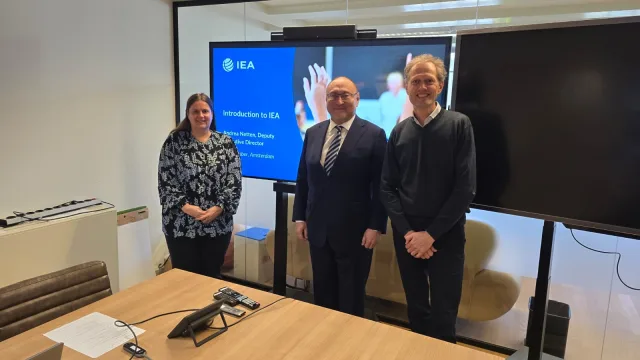
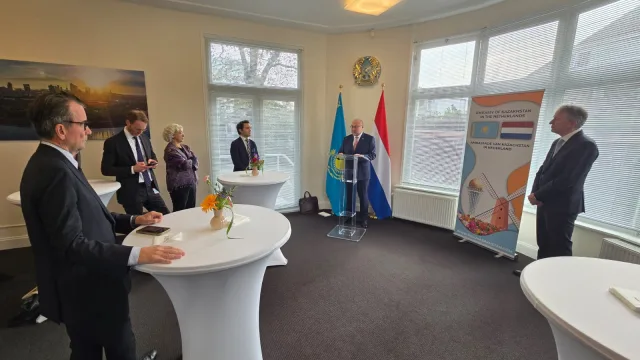
Maastricht, 13 November 2026– On 12 November, Ambassador of the Republic of Kazakhstan to the Netherlands Akan Rakhmetullin visited Maastricht University, one of the country's leading research universities, renowned for its international academic environment and innovative approaches to education.
Background: Founded in 1976, Maastricht University celebrates its 50th anniversary in 2026. It is one of the most internationally oriented universities in the Netherlands, with more than 22,000 students, approximately 62% of whom are international students representing over 120 nationalities. The university comprises six faculties and is particularly known for its innovative Problem-Based Learning (PBL) approach.
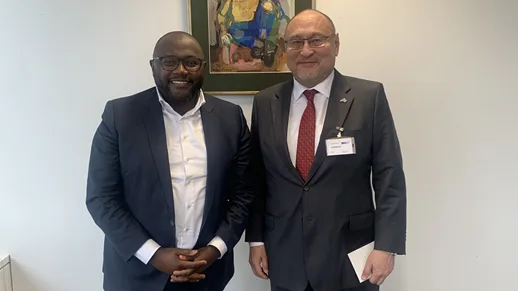
At the beginning of the visit, the Ambassador met with Professor Ronald Janse, Dean of the Faculty of Law, and Dr. Fabián O. Raimondo, Associate Professor of Public International Law. The parties discussed prospects for academic cooperation between Kazakhstan and the Netherlands, including establishing direct links between universities, conducting joint research, facilitating student and faculty exchanges, and promoting cooperation in international law and international relations.
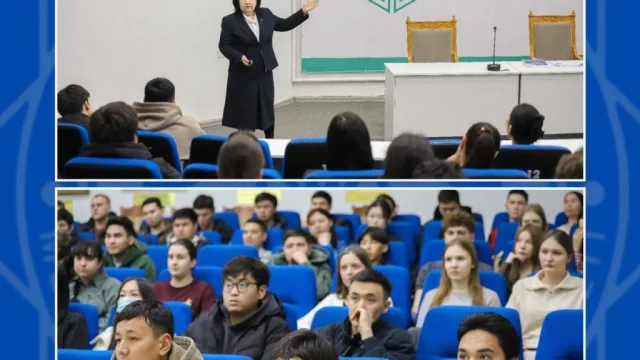
At the invitation of the Faculty of Law, Ambassador Rakhmetullin delivered a lecture to students and faculty members entitled "Kazakhstan in a Changing Eurasia: Navigating Relations with Russia, China and the European Union."
The lecture, held in the year marking the 35th anniversary of Kazakhstan's Independence and shortly after the celebration of Republic Day, covered the country's historical development, ongoing political and economic transformations, and its position in the evolving international order.
Opening his lecture, the Ambassador highlighted the historical significance of the Declaration of State Sovereignty adopted on 25 October 1990 and Kazakhstan's achievements since independence. He introduced the audience to the rich historical and cultural heritage of the Great Steppe, the Great Silk Road and the Golden Horde, emphasizing their role in shaping Kazakh statehood and fostering connections across Eurasia. In this context, he also referred to international academic and cultural events held in Kazakhstan to study and promote the heritage of the Ulus of Jochi and the Golden Horde.
Turning to the country's contemporary development, Ambassador Rakhmetullin outlined the political and institutional reforms initiated by President Kassym-Jomart Tokayev, including the entry into force of the new Constitution, the transition to a unicameral Parliament and the establishment of the People's Council (Halyk Kenesi). He noted that these reforms are aimed at strengthening state institutions, upholding the rule of law and improving the effectiveness of public administration.
Particular attention was paid to President Tokayev's State of the Nation Address of 28 October 2026, entitled "Kazakhstan's Current Priorities in a New Historical Cycle." The Ambassador presented its key priorities, including infrastructure modernization, economic diversification, improving the investment climate, developing industry and entrepreneurship, expanding transport and logistics capacity, strengthening energy and water security, and advancing digitalization and the adoption of artificial intelligence.
The main part of the lecture focused on Kazakhstan's foreign policy strategy amid the transformation of the international order and intensifying geopolitical competition. The Ambassador emphasized that the country's balanced foreign policy is based on protecting national interests, preserving sovereignty, upholding the principles of international law and maintaining pragmatic relations with different centres of power.
Discussing Kazakhstan's relations with Russia, China and the European Union, the diplomat outlined the distinctive features of each partnership, highlighting Kazakhstan's commitment to maintaining independent foreign policy decision-making, diversifying its economic ties and strengthening the resilience of its national economy.
Special emphasis was placed on Kazakhstan's strategic partnership with the European Union and the Netherlands, which rank among the country's leading foreign investors. Critical raw materials, the energy transition, advanced technologies, sustainable logistics, agriculture and water management were identified as promising areas for further cooperation.
Considerable attention was also devoted to strengthening regional cooperation in Central Asia, developing the Trans-Caspian International Transport Route (Middle Corridor) as an important link between Asia and Europe, and addressing regional security challenges and the management of transboundary water resources.
In the context of current international challenges, Ambassador Rakhmetullin reaffirmed Kazakhstan's commitment to the principles of the United Nations Charter, respect for the sovereignty and territorial integrity of states, the peaceful settlement of conflicts, nuclear disarmament and non-proliferation.
The lecture generated keen interest among students and faculty members, as reflected in a lively question-and-answer (Q&A) session. The open discussion addressed current geopolitical developments, Kazakhstan's foreign policy priorities and Central Asia's role in international relations. The exchange contributed to a deeper understanding of Kazakhstan's historical heritage, ongoing reforms and international role, while also helping to strengthen academic ties between the two countries.
Follow memleket.kz on social media
Important news from Kazakhstan and useful articles on the platform you prefer.