Mobile Transfers: In Which Cases Can They Attract the Attention of Tax Authorities?
Which transfers fall under monitoring?
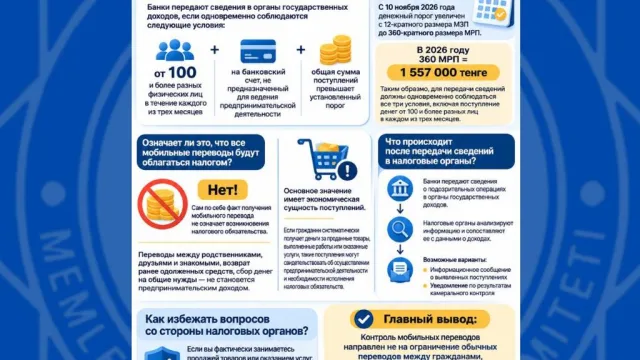
The criteria under which banks transmit information to state revenue authorities regarding receipts into personal accounts of individuals, provided that the following conditions are met:
· money is received from 100 or more different individuals during each of three consecutive calendar months;
· receipts are deposited into a bank account not intended for conducting business activity;
· the total amount of receipts for the specified three-month period exceeds the established monetary threshold.
At the same time, it is important to take into account that from November 10, 2026, the monetary threshold has been increased from 12 times the minimum wage (MW) to 360 times the monthly calculation index (MCI).
In 2026, 360 MCI equals 1 557 000 tenge. Thus, for the transmission of information, all three conditions must be met simultaneously, including the receipt of money from 100 or more different individuals in each of the three months.
Does this mean that all mobile transferswill be taxed?
No. The fact of receiving a mobile transfer does not mean the presence of a tax liability.
Transfers between relatives, friends, and acquaintances, repayment of previously borrowed funds, collection of money for shared needs, and other personal receipts do not become business income due to their quantity or amount.
The economic substance of the receipts is of primary importance. If a citizen systematically receives money for sold goods, performed work, or provided services, such receipts may indicate doing business and the need to fulfill corresponding tax obligations.
What happens after informationis transmittedto the tax authorities?
Upon identifying transactions that meet the established criteria, banks transmit information to the state revenue authorities. Next, tax authorities analyze the received information and cross-reference it with existing records on income and fulfillment of tax obligations.
At the first stage, an informational message regarding the identified receipts may be sent to the citizen. In itself, such a message does not constitute a notice of violation and does not require automatic payment of tax. If further analysis reveals discrepancies, a notice based on cameral audit results may be issued to the taxpayer.
In that case, it is necessary to review its content and submit explanations or eliminate the identified discrepancies in accordance with the established procedure.
How to avoid questions from tax authorities?
If a citizen is actually engaged in selling goods or providing services, it is recommended to timely register business activity, select an appropriate tax regime, and use a bank account intended for business transactions.
Thus, the monitoring of mobile transfers is aimed not at restricting ordinary transfers between citizens, but at identifying potential cases of receiving undeclared income from business activity. Law-abiding citizens using mobile transfers for personal purposes need not fear the fact of receiving funds on a bank card.
Follow memleket.kz on social media
Important news from Kazakhstan and useful articles on the platform you prefer.